Skin boosters and polynucleotides are both injectable treatments used to improve skin quality, but they achieve this in different ways.
A skin booster primarily focuses on hydration, helping the skin feel smoother, softer and more supple. Polynucleotides take a more regenerative approach, supporting cellular activity and the natural processes involved in skin repair and renewal.
At Takroni Clinic in Fitzrovia, understanding these differences helps us match treatment more closely to what the skin needs. Skin that would benefit from greater hydration may respond particularly well to a skin booster, while polynucleotides can be useful when the aim is to support elasticity, resilience and overall skin quality over time.
Both treatments have an important place in skin rejuvenation. The key is understanding how each works, where their benefits differ and which approach best matches the condition of your skin.
What Are Skin Boosters and How Do They Work?
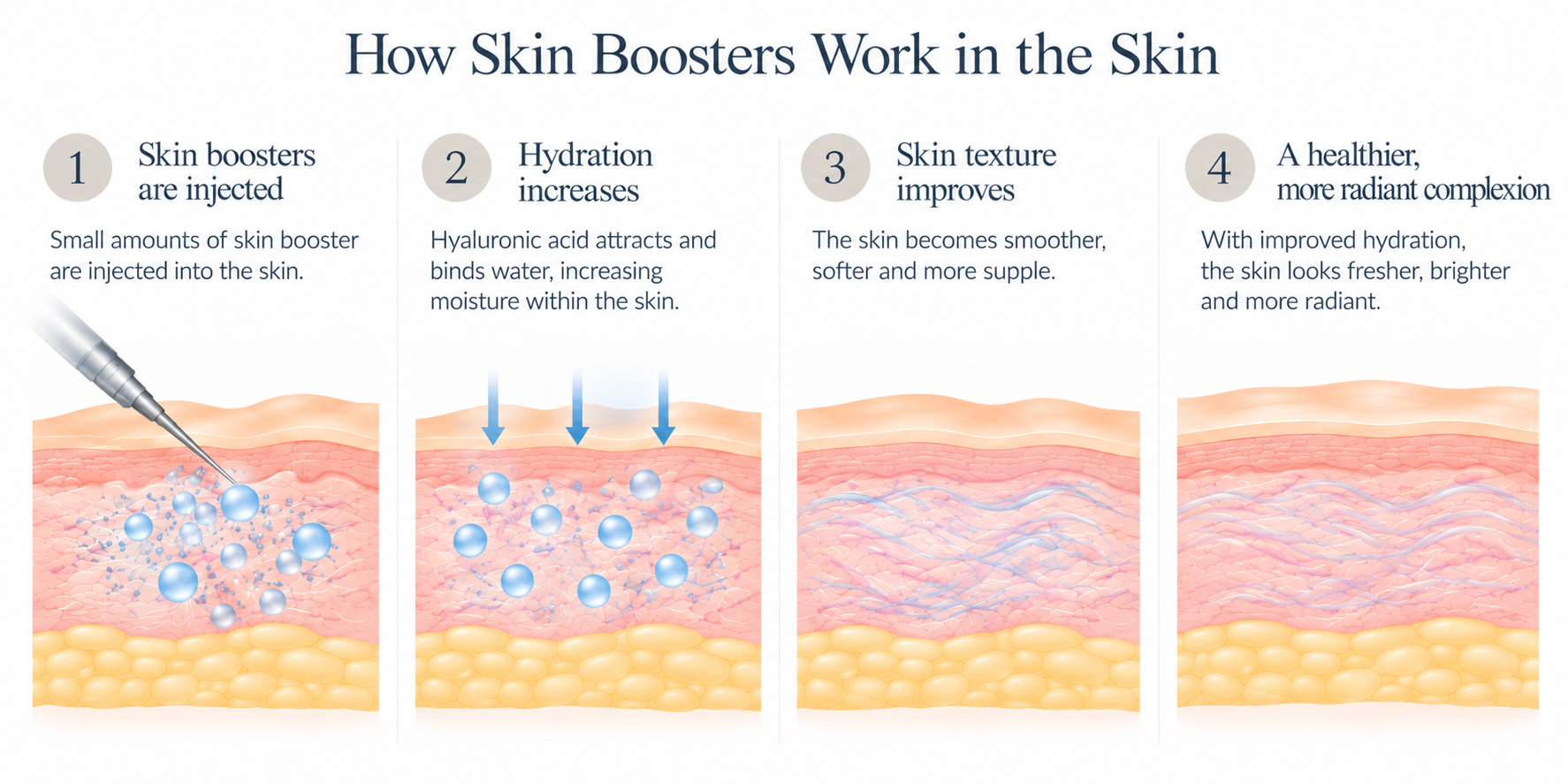
Skin boosters are injectable treatments that place hydrating ingredients directly within the skin. At Takroni Clinic, Skin Smoothing Mesotherapy Boosters aka BabyGlow contain a light form of hyaluronic acid alongside antioxidants, vitamins, minerals and amino acids.
Hyaluronic acid is a substance naturally present within the body and has a strong ability to bind water. This makes it useful for improving hydration within the skin. It is also an ingredient found in many dermal fillers, which can understandably cause some confusion. The important difference is how the product is formulated and used. A dermal filler is generally placed strategically to provide volume, contour or structural support. With a skin booster, small quantities are distributed within the skin itself. The intention is not to change facial proportions but to improve the environment within the skin.
As hydration improves, the skin can become softer and more supple. Fine lines caused partly by dehydration may appear less obvious, while the surface can look smoother and fresher.
This is why skin boosters are commonly associated with concerns such as:
- Dehydration
- Dullness
- Rough or uneven texture
- Fine dehydration lines
- Loss of suppleness
They are not, however, a treatment for every sign of skin ageing. Increasing hydration does not replace significant lost volume, tighten established laxity or correct pigmentation.
What Are Polynucleotides and What Do They Do to the Skin?
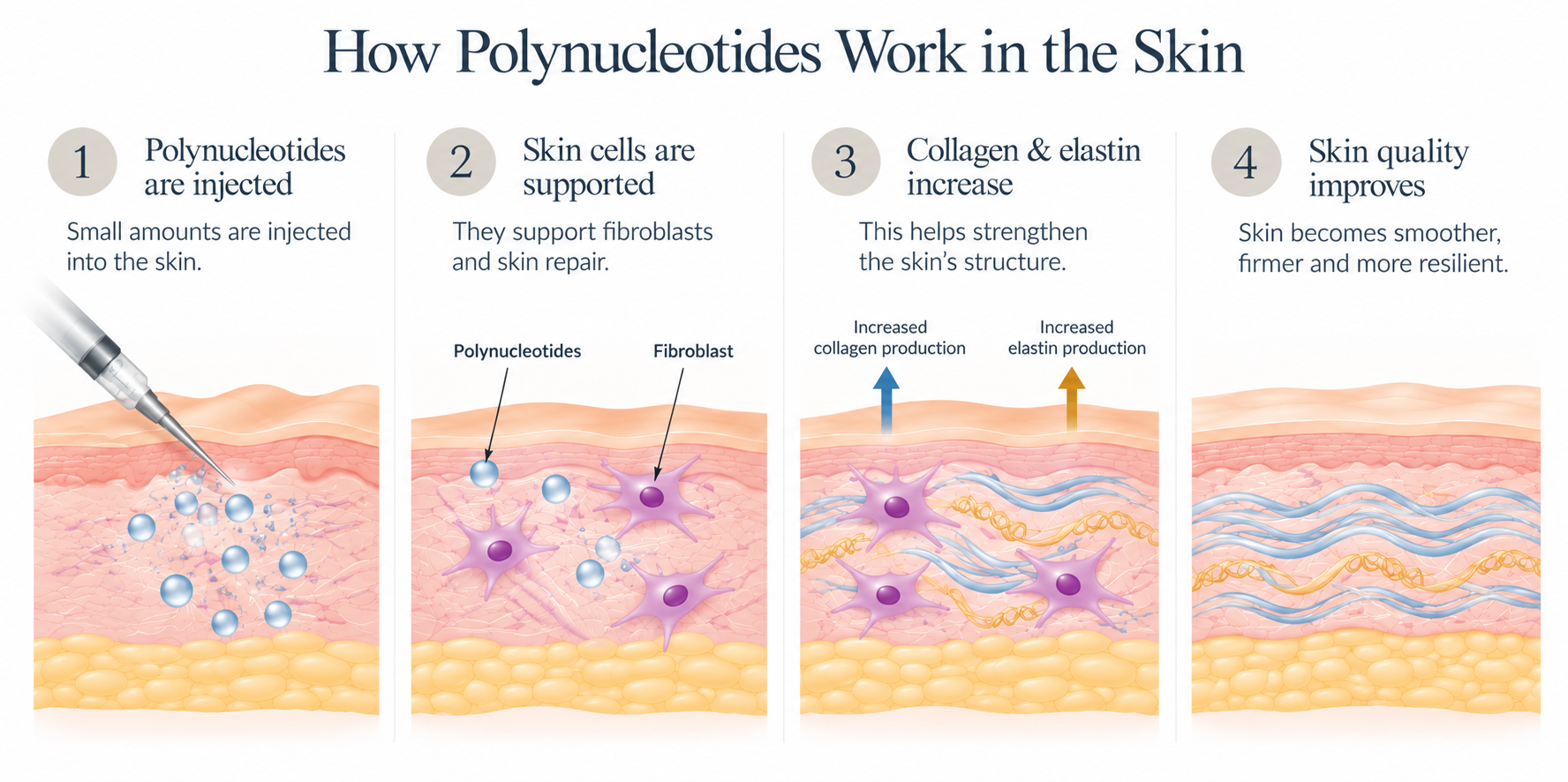
Polynucleotides work through a different mechanism. They consist of highly purified fragments of DNA and are injected into the skin to support its regenerative environment. Rather than primarily supplying hydration, the aim is to influence biological processes involved in tissue repair and skin quality.
One of the key areas of interest is fibroblast activity. Fibroblasts are cells within the connective tissue that contribute to the production and maintenance of collagen, elastin and other components of the extracellular matrix. These structures help give skin its strength, elasticity and resilience.
As we age, these processes change. Collagen production becomes less efficient, existing collagen becomes more fragmented and skin gradually loses some of its thickness and elasticity. This is why ageing skin does not simply become “dry”. Its structure is changing too. Polynucleotides are used to support this regenerative environment, with the aim of gradually improving characteristics such as texture, elasticity, hydration and skin thickness. The distinction is subtle but important. The treatment is not filling individual wrinkles. It is attempting to improve the quality of the tissue in which those wrinkles are developing.
What Is the Main Difference Between Skin Boosters and Polynucleotides?
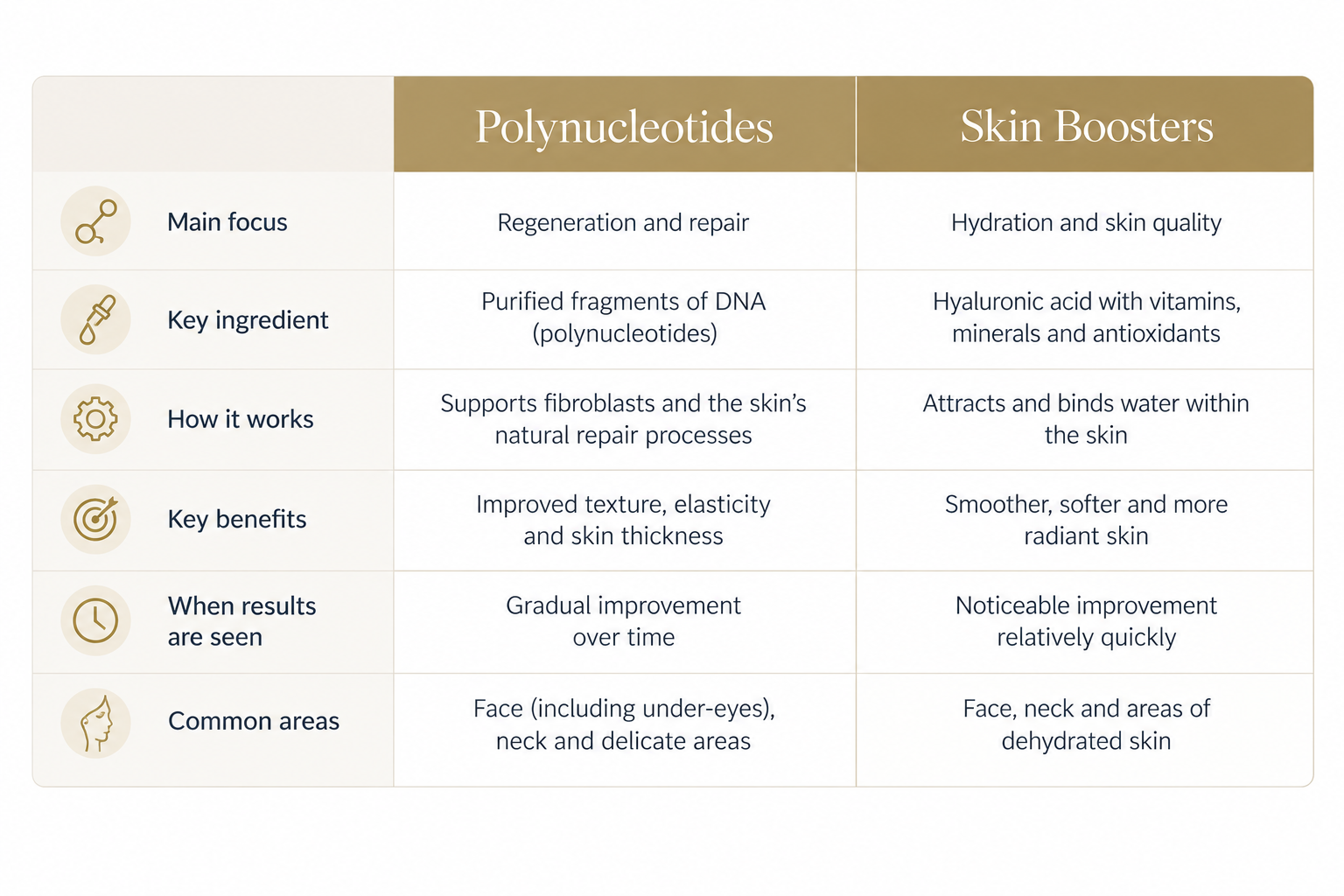
The main difference between skin boosters and polynucleotides is how they improve the skin.
Skin boosters primarily improve hydration. They usually contain hyaluronic acid, which attracts and retains water within the skin. This can improve softness, smoothness and suppleness, making them particularly useful when skin feels dehydrated, dull or lacks its usual freshness.
Polynucleotides work more regeneratively. Rather than focusing mainly on adding hydration, they support fibroblast activity and the skin’s natural repair processes. Over time, this can help improve qualities such as elasticity, texture, thickness and resilience, which is why they can be particularly useful for thin or crepey skin.
There is some overlap. Skin boosters can improve more than hydration alone, while polynucleotides can also support hydration. The difference is where the main emphasis lies.
A simple way to think about it is: skin boosters help replenish and hydrate the skin, while polynucleotides help support its repair and regeneration. Which is more appropriate depends on whether the main priority is hydration and smoothness or improving the underlying quality and resilience of the skin.
Do Skin Boosters and Polynucleotides Treat Wrinkles?
They can improve the appearance of some fine lines, but neither should be thought of simply as a wrinkle treatment.
A wrinkle can develop for several reasons. Repeated facial movement contributes to some lines. Others become more noticeable because of collagen loss, declining elasticity, dehydration or changes in facial volume. Sun exposure can also accelerate structural changes within the skin. This means the same visible symptom can have several underlying causes. A fine line caused partly by dehydration may soften as skin hydration improves following a skin booster. If the surrounding tissue has become thin and less elastic, improving its quality with polynucleotides may be more relevant.
More established wrinkles are often multifactorial, which is why expecting either treatment to “erase wrinkles” creates unrealistic expectations.
How Do the Results Develop Differently?
Skin boosters and polynucleotides also differ in the way patients tend to experience their results. Because skin boosters are strongly associated with hydration, improvements in softness, suppleness and freshness may become noticeable relatively quickly as the skin responds. Polynucleotides are better understood as a progressive treatment.
The biological processes being targeted take time. Treatment is therefore usually carried out as a course rather than judged immediately after one session. This gradual development is an important part of regenerative treatment. The goal is not to inject something that temporarily creates the appearance of thicker tissue. Instead, we are trying to support processes occurring within the skin itself.
Neither approach is inherently preferable. The expected timescale simply reflects what the treatment is trying to achieve.
Can Skin Boosters and Polynucleotides Be Used Together?
Yes, because dehydration and structural changes within the skin can occur simultaneously.
Ageing is a good example. Skin may gradually become less efficient at maintaining hydration while collagen and elastin are also changing. Someone can therefore have skin that is both dehydrated and less resilient. In that situation, skin boosters and polynucleotides are addressing different aspects of the same overall concern.
This does not mean they automatically need to be combined. If dehydration is mild and the skin otherwise has good elasticity and thickness, improving hydration alone may be sufficient. Equally, someone undergoing polynucleotide treatment may not need an additional skin booster.
In clinical practice, there is value in doing enough to address the problem without adding treatment simply because treatments can technically be combined.
Skin Boosters vs Polynucleotides: How Do You Know Which Is Better?
Neither treatment is universally better. The better option is the one that matches what your skin needs.
If the main concern is dehydration, dullness, rough texture or fine dehydration lines, skin boosters are often the more appropriate choice because their primary role is to restore hydration and improve smoothness and suppleness.
If the skin has become thinner, crepey, less elastic or less resilient, polynucleotides may be more suitable because they focus on supporting repair and regeneration within the skin. This can be particularly relevant for delicate areas such as around the eyes.
Some patients have both dehydration and changes in skin quality, in which case the treatments can also be used as part of the same skin plan. At Takroni Clinic, the decision is therefore based on the condition of the skin and the changes we are trying to improve, rather than age alone.
FAQs About Skin Boosters and Polynucleotides
Are polynucleotides a type of filler?
No. Polynucleotides are not used in the same way as dermal fillers. Their purpose is to support skin quality and regenerative processes rather than create significant facial volume or projection.
Are skin boosters just injectable moisturiser?
That description is an oversimplification. Hydration is an important part of how skin boosters work, but delivering hyaluronic acid and other ingredients within the skin is different from applying a moisturiser to its surface.
Can younger skin benefit from either treatment?
Potentially, but age alone is not an indication for treatment. A younger person may experience significant dehydration, while another person of the same age may have healthy skin that requires no injectable treatment at all.
Why Do Skin Boosters and Polynucleotides Usually Require a Course of Treatments?
Both skin boosters and polynucleotides work progressively, so multiple sessions are usually recommended to achieve the best results. Skin boosters typically involve a course of three treatments to improve hydration and skin quality, while polynucleotides are delivered over a series of sessions to support gradual skin repair and regeneration. The number and spacing of treatments will depend on the product used, your skin concerns and your individual response.
Do you still need skincare after skin boosters or polynucleotides?
Yes. Injectable treatments do not replace daily skin care. Cleansing, appropriate active ingredients, moisturisation and consistent sun protection continue to play an important role in maintaining skin health.
What Other Treatments Complement Skin Boosters and Polynucleotides?
Skin boosters and polynucleotides can work well alongside laser and light-based treatments when addressing multiple skin concerns. BBL HEROic can help improve pigmentation, redness and sun damage, while MOXI Tribrid and HALO Tribrid target concerns such as uneven texture, fine lines and signs of skin ageing.
Combining these treatments allows us to address skin hydration and regenerative support alongside more visible concerns with tone and texture. At Takroni Clinic, we assess your skin and recommend the most appropriate combination and treatment sequence based on your individual needs.
Understanding What Your Skin Needs
The distinction between skin boosters and polynucleotides becomes much clearer once we stop viewing them simply as two competing injectable treatments.
Skin boosters primarily help when the skin needs hydration and improved suppleness. Polynucleotides are used when the aim is to provide regenerative support and improve qualities such as resilience, elasticity and thickness.
There is overlap, and some people have concerns that involve both. The important part is identifying what is actually responsible for the change you can see.
At Takroni Clinic in Fitzrovia, London, a Skin Consultation allows us to assess these factors before deciding whether an injectable treatment is appropriate at all. For patients considering skin boosters or polynucleotides from Fitzrovia, Marylebone, Mayfair, Soho and elsewhere in Central London, treatment can then be selected according to the condition of the skin rather than simply following the latest trend.
If you would like to understand what is happening to your skin and the options available, you can book a consultation with the Takroni Clinic team.

