
For years, aesthetic medicine was largely associated with looking younger. The focus was often on what could be removed, softened or replaced: fewer wrinkles, more volume and fewer visible signs of age.
Today, many patients are looking for something different. Rather than trying to recreate the face they had ten or twenty years ago, they want to age well. They want their skin to remain healthy, strong and resilient, while still looking recognisably like themselves. One of the most important parts of that conversation is collagen.
Collagen provides much of the structural support within our skin, but the way our bodies produce and maintain it changes as we get older. This gradual decline contributes to many of the changes people associate with skin ageing, from fine lines and thinning skin to reduced firmness and elasticity.
This is also why modern aesthetic treatments are increasingly focused on encouraging the skin to regenerate and remodel itself, rather than simply trying to disguise every visible sign of age.
At Takroni Clinic, supporting long-term skin quality is an important part of treatment planning. The question is not simply, ‘How can we make somebody look younger?’ It is often more useful to ask, ‘What does this skin need to remain healthy as it ages?’
Why Is Collagen So Important for Healthy Skin?
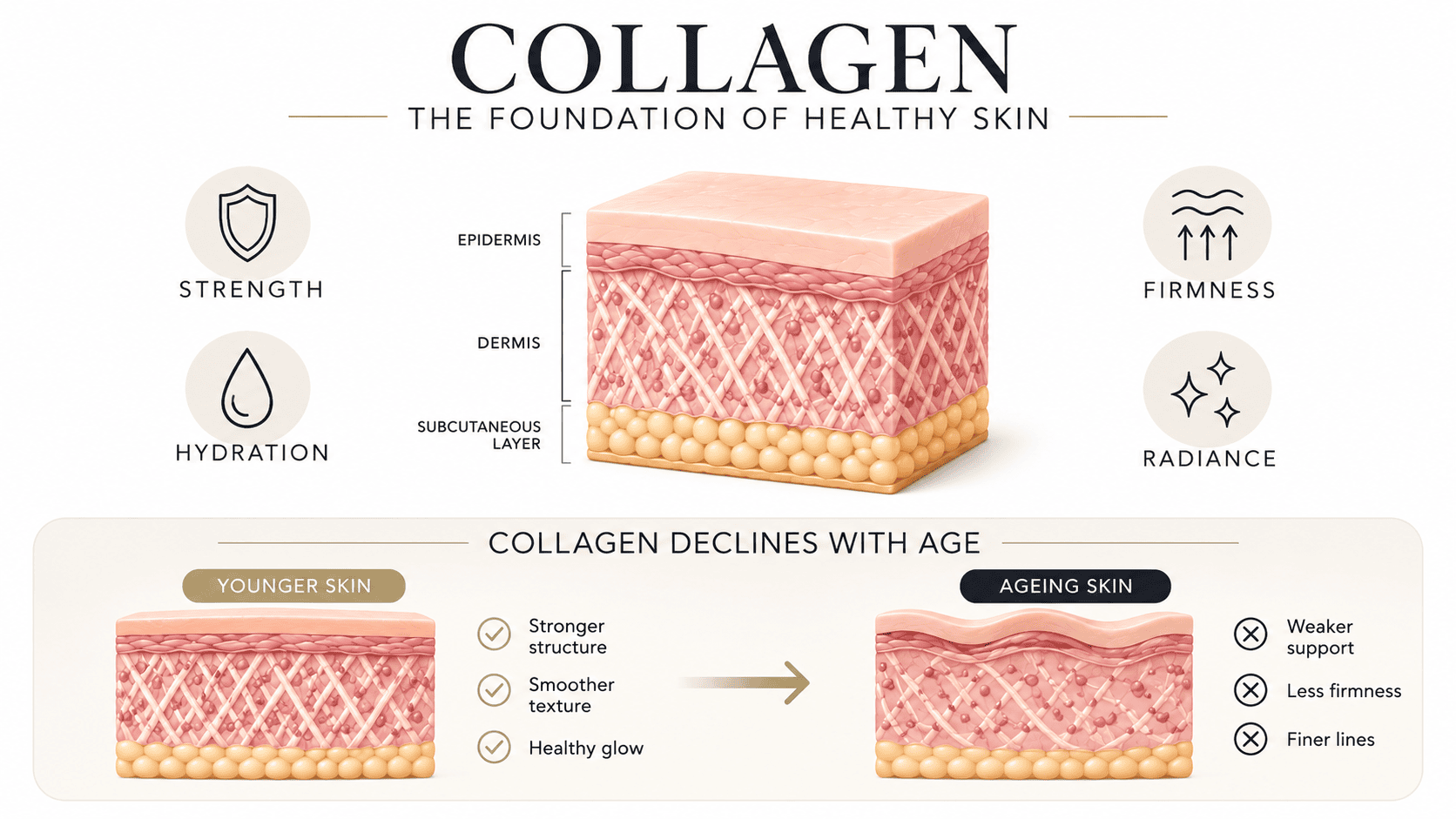
Collagen is one of the main structural proteins in the skin. A useful way to think about it is as part of the skin’s internal scaffolding. Within the dermis, collagen fibres help provide strength, density and support, while elastin contributes to the skin’s ability to stretch and return to shape.
When this supportive network is healthy, the skin tends to feel firmer and more resilient. However, collagen is not static. Our bodies are continually breaking it down and producing new collagen as part of normal tissue maintenance. As we get older, that balance gradually changes. The production of new collagen slows, while existing collagen continues to break down. Over time, the supportive network within the skin becomes less dense. As we lose collagen in our skin this will present as dullness, pigmentation, larger pores as well as lines and wrinkles
At What Age Do Collagen Levels Start to Decline?
Collagen production begins to slow from around our mid-twenties and continues to decline at a rate of about 1 – 1.5% a year gradually as we age. When we hit the menopause it can decline up to 6x quicker. However, there are so many topicals and treatments that are proven to protect your remaining collagen and stimulate new collagen so you are able to take back some of that control.
You might begin to notice that:
- skin does not feel quite as firm as it once did
- fine lines remain visible for longer
- the skin feels thinner or more delicate
- texture becomes less smooth
- areas begin to look slightly crepey
- the skin has less of its previous ‘bounce’
- Increased pigmentation or sundamage
- Pores appearing larger over time
The rate at which these changes become noticeable varies considerably.
Genetics play a role, but external factors matter too. In particular, repeated ultraviolet exposure can contribute to collagen breakdown and premature skin ageing. Smoking and other lifestyle and environmental factors can also influence the condition of the skin. This is one reason two people of exactly the same age can have very different skin.
Can We Encourage the Skin to Produce More Collagen?
This is one of the most interesting areas of modern aesthetic medicine. Rather than simply placing something into the face to replace what appears to have been lost, certain treatments are designed to create a controlled response within the skin that encourages collagen production and remodelling.
The mechanisms differ depending on the treatment. Some use carefully controlled micro-injury to trigger the skin’s natural repair response. Others combine this with energy delivered into deeper layers of tissue. Biostimulatory injectables work differently again, encouraging collagen production gradually after being introduced into the tissue.
The common idea is that the improvement depends, at least partly, on the skin responding and rebuilding over time. That means results are not always immediate. For patients accustomed to treatments where the difference can be seen straight away, this can require a different mindset. Collagen takes time to form and remodel, so improvements in firmness, texture and skin quality tend to develop progressively. Think of it like building muscle at the gym which takes time. The key to success is consistency and maintenance once you reach your goals.
In many ways, that is exactly why collagen stimulation fits so naturally with the concept of ageing well.
How Does JULÄINE™ Stimulate Collagen?
At Takroni Clinic, JULÄINE™ is one option for patients who want to improve the skin’s underlying support by encouraging their own collagen production.
Unlike traditional filler, it is not primarily designed to immediately add volume or reshape a facial feature. Instead, JULÄINE™ works gradually. Following treatment, it encourages organised collagen production within the skin, with improvements developing over the following weeks and months.
As that process continues, patients notice improvements in firmness, elasticity, texture and the overall quality of the skin. This makes it particularly relevant when the concern is that skin feels less firm or resilient rather than there being an obvious hollow that needs filling. The distinction matters. If the main issue is declining collagen support, simply adding more volume may create fullness without addressing the quality of the skin itself.
JULÄINE™ represents a different philosophy: rather than trying to create an immediate ‘younger’ face, the aim is to support gradual improvement in the skin’s own structure.
How Does Medical Microneedling Support Collagen?
Collagen stimulation does not always require an injectable treatment.
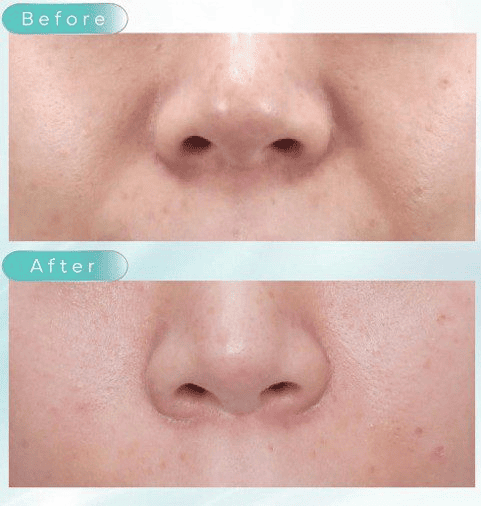
At Takroni Clinic we regularly recommend medical microneedling using the skinpen device. The Skinpen device is considered one of the safest and most effective on the market for this treatment. Medical microneedling works by creating very small, controlled microchannels within the skin. With the Skinpen you get 98,000 channels in the skin per minute. These controlled injuries trigger the body’s natural healing response, which includes the production and remodelling of collagen and elastin. The principle is relatively simple: the skin is encouraged to repair itself. Over time, this can improve concerns such as fine lines, uneven texture,and mild acne scarring while supporting general skin quality. It can be particularly useful when texture is an important part of the concern.
The results are again progressive rather than instant. The initial healing happens relatively quickly, but collagen remodelling continues after the skin’s surface has recovered. This is why a course of 3-6 treatments may be recommended to reach significant improvement in collagen production rather than expecting one session to completely transform the skin.
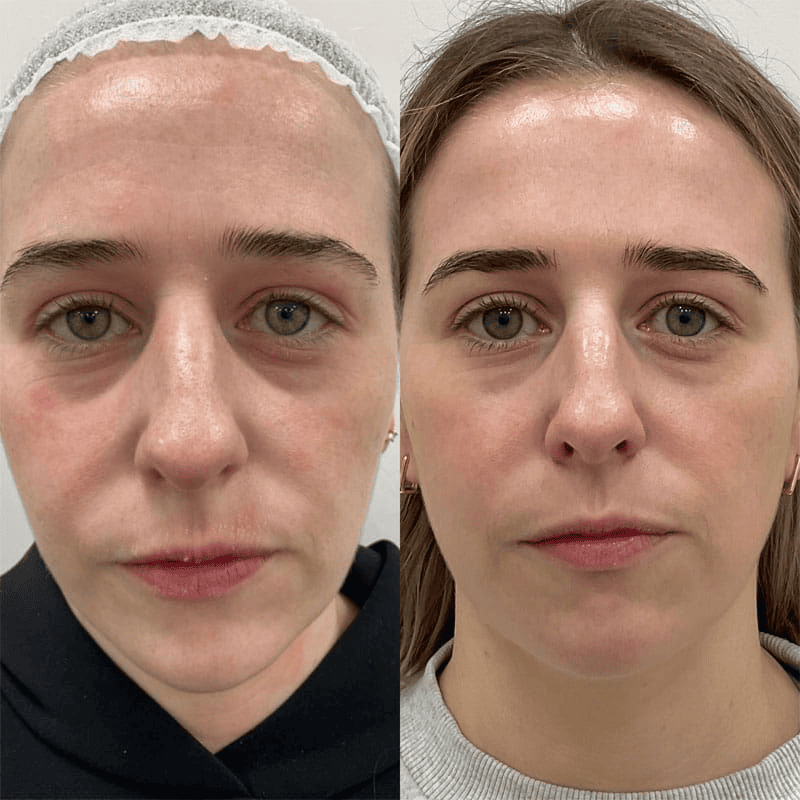
3 sessions of Skinpen medical microneedling
Can Laser Treatments Help Stimulate Collagen?
Yes. Laser and light-based treatments can also play an important role in supporting collagen while addressing visible changes such as pigmentation, uneven texture, enlarged pores and sun damage.
At Takroni Clinic, the treatment we recommend depends on how much correction the skin needs.
For earlier signs of ageing, Clear + Brilliant offers a gentle approach to improving skin quality and stimulating collagen renewal. Where pigmentation, redness and textural changes are becoming more noticeable, BBL HEROic™ + MOXI TRIBRID™ can be combined to address both skin tone and texture while supporting collagen production.
For more established sun damage, lines or textural changes, HALO TRIBRID™ allows us to work at multiple levels of the skin for more comprehensive rejuvenation and collagen remodelling.
The aim is not simply to choose the strongest treatment available. It is to match the level of treatment to the condition of the skin, with more intensive options considered only where greater correction is needed.
Can Collagen Treatments Be Combined?
Ageing skin rarely has only one concern. Someone may have declining firmness alongside uneven texture, pigmentation or changes in hydration. Different treatments can therefore be used for different purposes rather than expecting one procedure to solve everything. For example, a collagen-stimulating injectable may be used to support gradual improvements in firmness, while microneedling or an energy-based treatment addresses texture.
Polynucleotides are another regenerative option available at Takroni Clinic and may be considered where improving skin quality, elasticity and thickness is the priority, including in delicate areas such as around the eyes. The important part is that combination treatment should have a reason behind it.
More treatments do not automatically mean more collagen, nor do they guarantee better results. Skin needs time to heal and remodel, which is why treatments may be staged rather than performed all at once.
Ageing Well Is About Supporting Your Skin
You do not need to wait until skin ageing becomes advanced before thinking about collagen health, but that does not mean starting aesthetic treatments at a particular age.
Protecting collagen begins with the basics. Daily sun protection, consistent clinically proven skincare and avoiding smoking can all help support long-term healthy skin.
Great skin looks good on all ages and therefore we recommend considering starting treatments such as microneedling from your late 20s when you are no longer producing your own collagen. As signs such as pigmentation, dullness and enlarged pores appear we may recommend lasers to help tackle these concerns.
However, it is never too late to start tricking your skin into creating new collagen and at Takroni clinic we have a laser to address any level of concern from our intro laser clear and brilliant all the way to our erbium deep laser resurfacing treatment for very advanced signs of ageing.
FAQs About Collagen and Ageing Skin
Can you rebuild all the collagen you lose with age?
No aesthetic treatment can permanently stop or reverse the natural ageing process. Collagen-stimulating treatments such as microneedling and lasers are used to encourage new collagen production and tackle multiple signs of collagen loss such as pigmentation, dullness, enlarged pores and wrinkles. However, in order to maintain results you need to be diligent with your skincare and have maintenance sessions. Patients often report that their skin feels the best it has in years post treatments.
Does more collagen always mean tighter skin?
Not necessarily. Skin laxity is influenced by several factors, including collagen, elastin and deeper facial structures. This is why the cause and severity of laxity need to be assessed before recommending treatment. Severe laxity would often benefit from surgical intervention, however, even surgery will not improve skin quality so surgeons often recommend lasers and microneedling before and after surgery for the best possible results. The appearance of minor laxity can often be improved with a combination of skin quality treatments and injectables such as Julaine and dermal fillers.
Can collagen treatments help the eye area?
Certain treatments can be considered for the delicate skin around the eyes. We have injectable treatments such as polynucleotides, sunekos and julaine. These help to hydrate the skin around the eyes and build collagen. We also now offer erbium deep laser resurfacing for the eye area. Think of this as a next generation C02 laser with incredible results but reduced risks.
Do I need collagen-stimulating treatments every year?
Treatment courses and maintenance depend on the procedure, your skin and how it responds. A personalised plan will be created for you where we discuss what maintenance will look like for you depending on your individual skin type and concerns.
Support Your Skin as It Ages
If your skin is beginning to feel thinner, less firm or less resilient, understanding why it has changed is the most useful place to start.
At Takroni Clinic in London, a consultation allows your skin quality, collagen support and individual concerns to be assessed before deciding which collagen-stimulating treatment may be appropriate.
Book an appointment at Takroni Clinic to discuss your concerns and find an approach that is right for your skin.