
Summer can leave behind more than a fading tan. After several months of increased UV exposure, warmer weather, holidays and changes to your usual skincare routine, you may start to notice that your skin looks different. Freckles and sunspots can appear darker, redness may be more visible, your complexion can look less even and areas of roughness or fine lines may suddenly seem more noticeable.
At Takroni Clinic in London, we tend to see this shift as summer comes to an end. Patients often come in saying their skin looks or feels ‘sun damaged’, but when we assess it properly, the picture can be quite different from one person to the next. One patient may mainly have pigmentation, while another has redness, uneven texture or several concerns appearing together.
This is why autumn is a popular time for laser skin treatments. However, it is not simply a case of choosing a laser and booking an appointment. The first step is understanding what summer has actually done to your skin, allowing it to recover where necessary and choosing a treatment that matches the changes we are trying to improve.
In this guide, we explain what happens to your skin after summer, why preparing your skin properly before laser matters, and how treatments such as BBL HEROic™, MOXI TRIBRID™ and HALO TRIBRID™ may be used for different post-summer skin concerns.
What Happens to Your Skin After Summer?
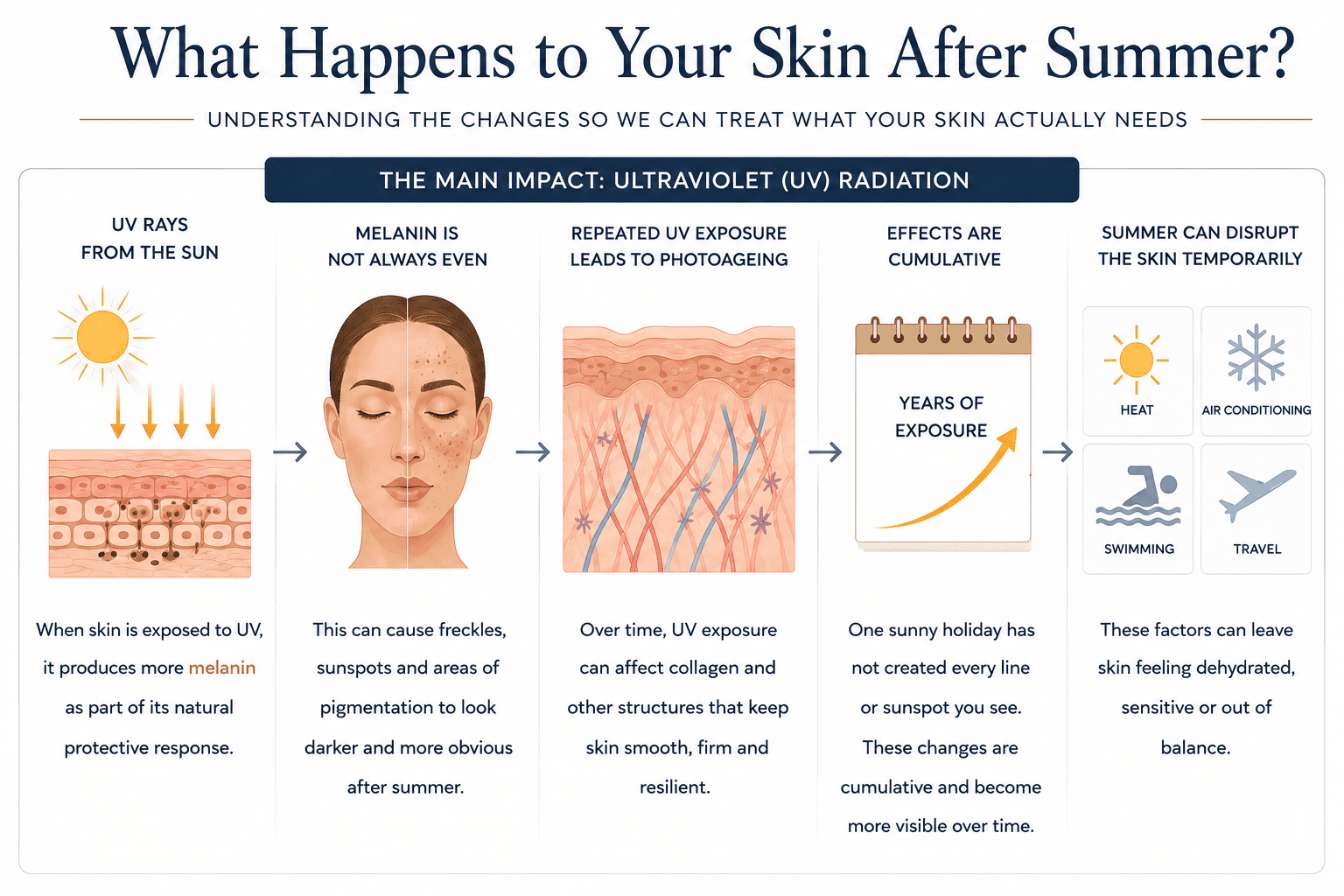
Summer can affect the skin in several ways. Increased UV exposure stimulates melanin production, which is why freckles, sunspots and uneven pigmentation can become more noticeable as the season comes to an end.
Repeated UV exposure also contributes to photoageing over time, affecting collagen and gradually influencing skin texture, firmness and fine lines. At the same time, heat, air conditioning, swimming and travel can leave the skin temporarily feeling dehydrated or more sensitive.
At Takroni Clinic, we often see patients after summer who describe their skin as simply “sun damaged”. In reality, the changes can be quite different from one person to another. Identifying whether the main concern is pigmentation, redness, texture or dehydration is therefore the first step before deciding whether laser treatment is appropriate.
How Should You Prepare Your Skin Before Autumn Laser Treatment?
Patients sometimes assume they need an elaborate “laser preparation” skincare routine. Usually, preparation is much simpler.
The aim is to arrive for treatment with skin that is healthy, stable and appropriately protected from UV exposure.
We generally want patients to avoid suddenly introducing lots of strong active ingredients, acids or exfoliants immediately before treatment. If these leave the skin irritated or sensitised, that is not a good starting point for a laser procedure.
Instead:
- Be consistent with daily sun protection, even once the weather becomes cooler.
- Avoid intentional tanning and tell us about any recent significant sun exposure.
- Keep your normal skincare routine consistent unless advised otherwise.
- Tell your practitioner about prescription skincare or stronger active ingredients you use.
- Let the clinic know if your skin becomes irritated, inflamed or unusually sensitive before treatment.
Medical grade skincare will likely form part of a longer-term plan, particularly where pigmentation, acne, dryness or photoageing need ongoing management.
Certain products may need to be adjusted around a laser appointment, but this should be personalised. Generally we recommend stopping retinol for 1 week prior to most skin treatments including facials, microneedling and lasers.
Which Laser Is Best for Different Post-Summer Skin Concerns?
Patients sometimes ask which is the “best” laser for sun-damaged skin, but there is no single answer.
The more useful question is: what are we trying to treat?
A patient whose main concern is pigmentation may require a different approach from someone bothered by roughness and enlarged pores. Someone with more established photodamage may need a different level of treatment again.
Darker Freckles, Sunspots or Redness: BBL HEROic™
Pigmentation is one of the most common changes we see after summer.
Many of our patients notice that freckles across their nose and cheeks have suddenly become darker, or that a few brown marks that were barely noticeable during winter now stand out much more clearly. However, not every brown mark is the same. We would not automatically treat an area simply because it looks like sun damage. Understanding what the pigmentation is and whether light-based treatment is appropriate comes first.
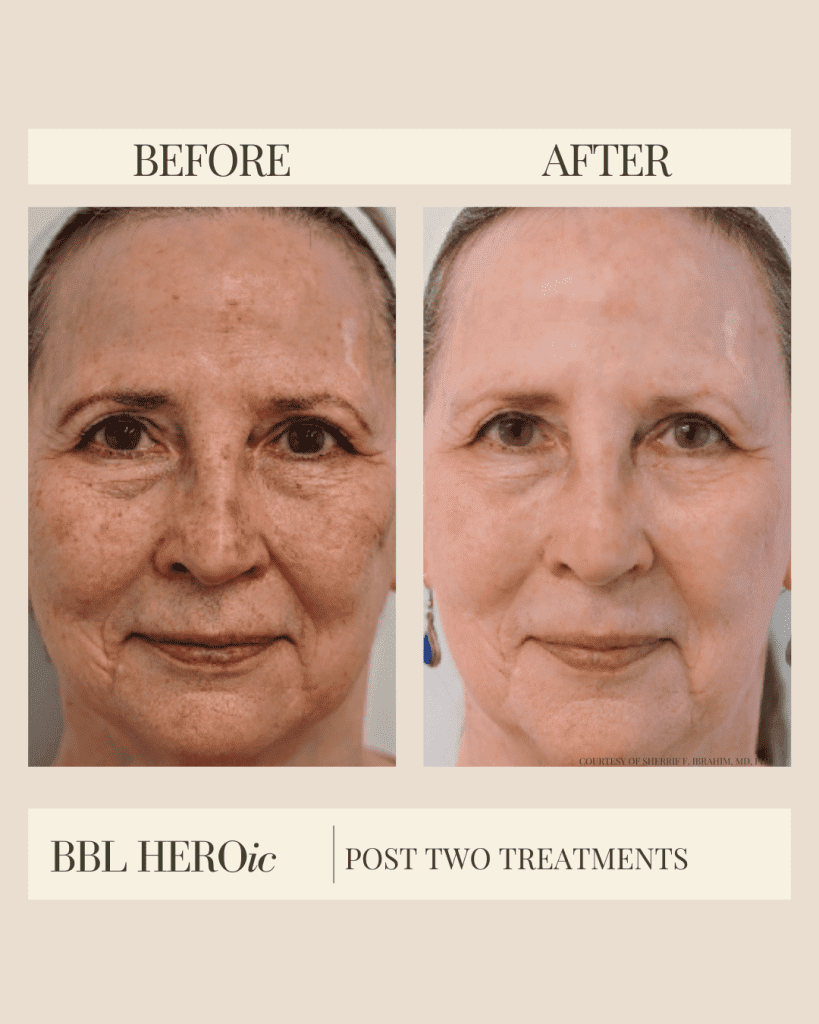
If the main changes after summer are increased pigmentation, sunspots or redness, BBL HEROic™ may be a suitable treatment option.
BBL stands for BroadBand Light, so BBL HEROic is technically an advanced light treatment rather than a traditional laser. In practice, we tend to think about it when colour is the main concern rather than texture.
For example, if someone’s skin remains relatively smooth but pigmentation and redness across the cheeks have become much more noticeable, we may want to concentrate on those colour changes rather than immediately moving towards resurfacing.
Rough Texture, Pores and Early Fine Lines: MOXI TRIBRID™
Other patients come to us with a slightly different concern. Their pigmentation may not particularly bother them, but their skin no longer feels as smooth or refined.
They might notice that pores appear more obvious, makeup is sitting differently or their complexion looks dull even after returning to their normal skincare routine. Fine lines can also become more apparent when skin has been dehydrated.
This is where MOXI TRIBRID™ may be a suitable choice. MOXI TRIBRID™ is the newer generation of MOXI, offering a faster and more powerful approach to non-ablative laser treatment. It can deliver up to twice the power of the original MOXI, allowing us to achieve greater correction within each session where appropriate.
The treatment can be customised to address concerns including uneven pigmentation, enlarged pores, fine lines and uneven texture. “Non-ablative” simply means that the laser works within the skin without fully removing its surface, with the treatment settings adjusted according to your skin and the degree of correction required.
For someone with relatively early changes, we would usually consider whether this level of treatment is enough before progressing to something more intensive.
Patients sometimes assume that the strongest laser must produce the best result. In practice, that is not how we approach treatment. The most appropriate laser is the one that matches what we are actually trying to improve.
Pigmentation and Uneven Texture: BBL HEROic™ + MOXI TRIBRID™
This is probably one of the most familiar scenarios after summer because skin concerns rarely fit neatly into one category. Someone may have developed more noticeable pigmentation across their cheeks while also feeling that their pores look larger and their skin has lost some of its smoothness.
In this situation, BBL HEROic™ and MOXI TRIBRID™ can be combined when appropriate because we are asking each technology to do a different job:
- Pigmentation and redness: BBL HEROic™
- Texture, pigmentation, pores and early fine lines: MOXI TRIBRID™
- Colour and texture concerns together: BBL HEROic™ + MOXI TRIBRID™
We would not combine treatments simply because doing more sounds better. If we assess someone whose only significant concern is pigmentation and whose texture is already very good, BBL alone may make more sense. Equally, if their colour is relatively even but texture and pores are bothering them, MOXI may be the more logical option.
Combination treatment is most useful when there is a clear reason for each part of the plan and speedier results are desired.
More Established Sun Damage, Signs of Ageing or Acne Scarring: HALO TRIBRID™
Not everybody coming in after summer has early or mild skin changes. We also see patients with more established photodamage. They may have pigmentation alongside lines and noticeable textural changes that have developed gradually after many years of sun exposure. That is a very different starting point from somebody who has noticed a few new sunspots after a holiday.
For more advanced concerns, we would normally consider whether a greater degree of resurfacing is appropriate. HALO TRIBRID™ combines 3 different wavelengths of laser including the 1927nm Moxi which works in the mid dermis, 2940nm erbium laser to resurface the skin (think of erbium as a next generation CO2 laser) and 1470nm laser which penetrates the deepest for deep dermal remodelling. This treatment can be completely personalised according to your skin type and concern.
We would not describe HALO TRIBRID™ simply as the “stronger” option, as the treatment can be carefully tailored to your skin type, concerns and the level of correction required. A better way to think about it is in terms of how comprehensively we need to treat the skin. If you would benefit from rejuvenation at multiple levels, addressing concerns such as pigmentation, texture and more established signs of sun damage together, we may recommend HALO TRIBRID™.
Is Laser Treatment Safe Straight After a Sunny Holiday?
We often see patients who return from an August holiday hoping to start their laser treatment as soon as September arrives. However, the change in season does not mean the increased melanin in the skin has immediately disappeared.
Recent tanning matters because many laser and light technologies interact with pigment. Your practitioner therefore needs to know about recent UV exposure, even if you feel that your tan is already beginning to fade.
This does not mean everybody has to wait until winter. It means the timing needs to be appropriate for your skin, rather than determined by the date.
The same principle applies throughout the year. A sunny October holiday can be just as relevant to your treatment planning as an August one.
We typically recommend 3-4 weeks after a sunny holiday is the safest time to have a laser. We of course recommend wearing SPF 30+ daily whilst on holiday to protect your skin in general.
Is Skincare Still Important After You Start Laser Treatment?
Laser treatment can improve appropriate existing concerns, but it does not make your skin immune to future UV exposure. In order for results to laser a maintenance plan is needed including skincare and repeat sessions at an appropriate interval for maintenance of skin health.
Skincare and lasers do different jobs. A laser may address a concern that skincare alone cannot adequately correct, while your everyday routine helps support and protect the skin between treatments. This is particularly important with pigmentation. Treating visible sun damage without addressing ongoing sun protection would be a very short-term approach.
Good results are therefore not only about what happens during your appointment. How you look after your skin before, between and after treatments matters too.
FAQs About Autumn Laser Treatment
Can I have laser treatment if I still have a tan?
Recent tanning should always be discussed during your consultation. Your skin needs to be assessed before deciding whether treatment can go ahead or whether it would be better to wait. We recommend 3-4 weeks after a sunny holiday to be safe.
Does wearing SPF all summer mean I can have laser straight away?
Not necessarily. SPF is essential, but we still need to consider your actual UV exposure, whether you have tanned and the current condition of your skin. If you have been properly wearing your SPF, are being very careful in the sun and you are committed to following the aftercare post laser then of course you can have treatments through the summer.
Can laser permanently remove sun damage?
Laser and light treatments can hugely improve signs of photodamage, but they cannot prevent new sun damage developing. Consistent sun protection, skincare, and maintenance treatments to upkeep results remains important afterwards.
Is autumn the only time you can have laser treatment?
No. Autumn is convenient for many patients because sun exposure can be easier to manage, but treatment timing ultimately depends on your skin, recent UV exposure and the procedure being considered.
How far before an important event should I have laser?
This depends on the treatment because recovery varies. If you have a wedding, holiday or important event coming up, mention it during your consultation so your treatment can be planned with enough recovery time.
Start by Understanding Your Post-Summer Skin
If your skin looks different after summer, the most useful first step is finding out why.
At Takroni Clinic in London, we can assess your pigmentation, redness, texture, recent sun exposure and overall skin quality before deciding whether skincare alone or a treatment such as BBL HEROic™, MOXI TRIBRID™, HALO TRIBRID™ or a combination approach is appropriate.
If you are considering laser treatment in London this autumn, book a skin consultation and we can create a treatment plan based on what your skin actually needs, rather than simply starting laser because summer is over.